
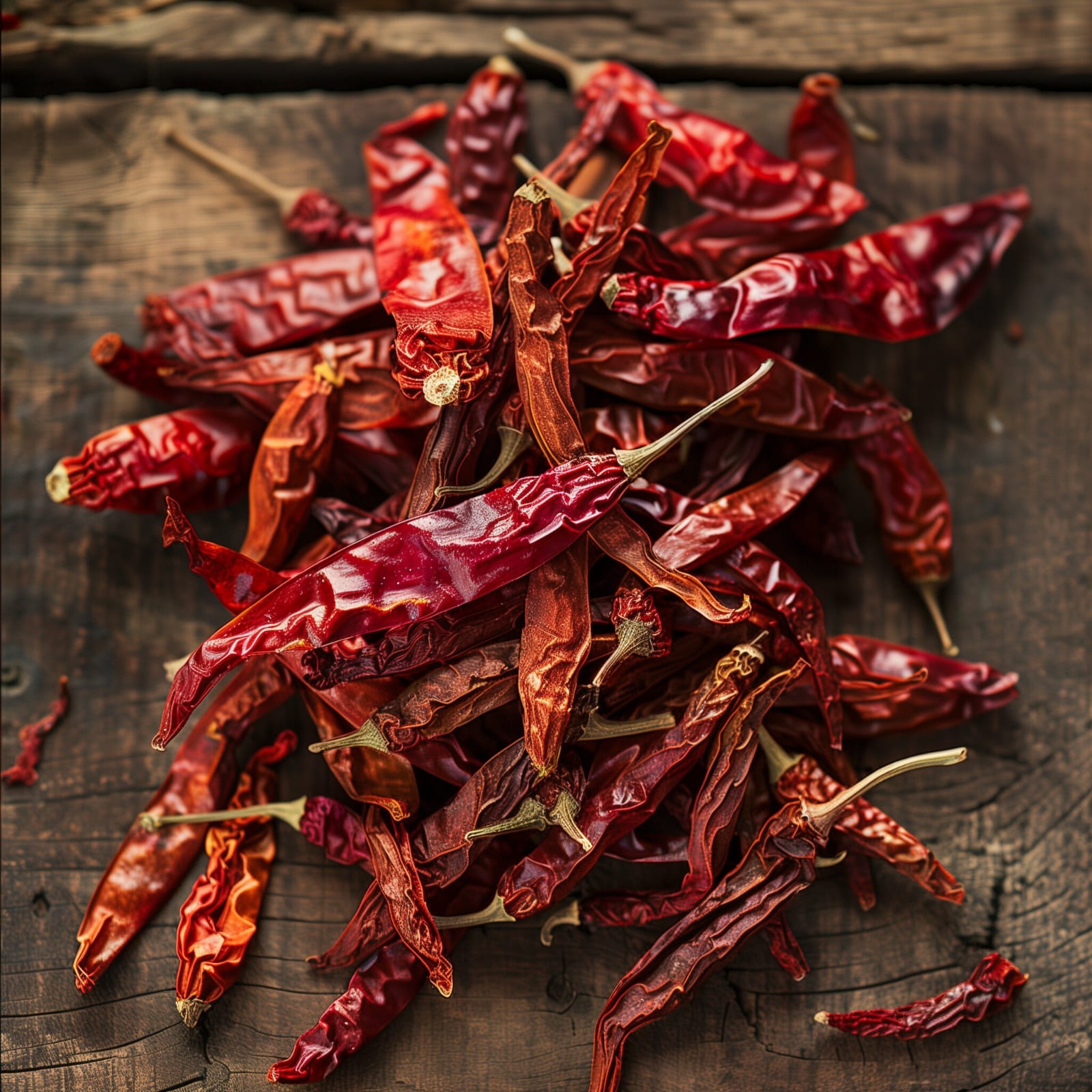
Guntur Sannam (S4) — The Benchmark Variety
Guntur Sannam, officially classified as S4, is the most widely traded Indian dry red chilli in both domestic and international markets. Grown primarily in the Guntur and Krishna districts of Andhra Pradesh, it carries a heat rating of 25,000–40,000 Scoville Heat Units (SHU) and an ASTA colour value of 80–100 — both high enough to qualify it as a dual-purpose variety suited to both colour-forward and heat-forward cooking.
The pods are medium-length (10–14 cm), moderately wrinkled, with a firm, thick skin. The deep red colour is consistent from tip to stalk when properly harvested at full ripeness and sun-dried correctly. Sannam’s flavour profile is characterised by a forward, sharp heat with a clean finish — no lingering bitterness, no floral notes. It is the correct variety for Andhra-style curries, rasam, sambar, and as the base chilli in most commercial spice blends. When most Indian recipes say “dried red chilli” without specifying a variety, Guntur Sannam is what is typically intended.
Teja (S17) — High Heat, Moderate Colour
Teja, or S17, is the highest-heat commercially traded South Indian chilli variety, with a heat rating of 50,000–100,000 SHU — roughly two to four times the heat of Sannam at peak. The pods are thinner and longer than Sannam, with a slightly lighter red colour (ASTA value typically 60–85). This lower colour-to-heat ratio is characteristic: Teja delivers intense, clean heat without the same depth of colour pigment as Sannam or Byadgi.
The heat from Teja is immediate and direct — a fast, high-intensity burn that clears quickly, without the slow build of some other high-heat varieties. Teja is the correct choice when extreme heat is required without a heavy chilli taste or deep red colour dominating the finished dish: vindaloo, very hot chutneys, certain pickle bases, and industrial spice blends. Teja grown in the Khammam and Guntur districts produces the highest capsaicin content due to specific soil mineral profile and climate stress the plants experience during the growing season.
Byadgi — Maximum Colour, Minimum Heat
Byadgi chillies come from the Byadgi region of Haveri district in Karnataka and are the most colour-rich commercially traded Indian chilli. They carry very low heat (8,000–15,000 SHU) but extremely high colour value (ASTA 120–180) — the highest of any commercially significant Indian variety. The deep burgundy-red colour that Byadgi produces in food is unmistakable.
Byadgi is available as two sub-types: Kaddi (long, thin, wrinkled pods) and Dabbi (shorter, fatter pods with deep folds). Both share the same defining characteristics. The thick, paprika-like skin retains more natural sweetness than other Indian varieties when dried. Byadgi is the chilli behind the colour of rogan josh, Chettinad curries, and any dish where deep red colour is the primary function. Using Byadgi where Sannam is needed will produce a dish that is too pale and mild; using Sannam where Byadgi is needed will produce a dish that is too hot and visually less striking.
334 Variety — Balanced Everyday Use
The 334 variety is a hybrid developed for the South Indian market, combining moderate heat (20,000–30,000 SHU) with good colour (ASTA 70–90) in a compact pod form. The pods are shorter and rounder than Sannam, with a smoother skin and fewer wrinkles. 334 is widely grown across Andhra Pradesh and Telangana and is often used in powders and blends where a balanced, predictable heat profile is needed across consistent batches.
Its relatively neutral flavour — less assertive than Sannam, not as extreme as Teja — makes it a versatile base for spice blends, pickles, and chutneys where the chilli is one element among many rather than the primary flavour. Home cooks who find Sannam too intense but want more character than Byadgi typically find 334 the most practical everyday variety.
Khammam Chilli — Telangana’s Regional Character
Khammam chillies, grown in the Khammam district of Telangana, are closely related to Guntur Sannam in heat level (25,000–45,000 SHU) and colour value (ASTA 75–95), but carry a distinctly different aroma profile. Where Sannam is sharp and direct, Khammam has a slightly earthier, more complex base note that comes from the specific soil mineral composition and microclimate of the Khammam growing region.
Khammam is used extensively in Telangana regional cooking and in certain pickle and condiment preparations where the regional flavour character is part of the identity of the dish. It is not as widely exported as Sannam but is traded heavily within the domestic Indian market. For buyers who want the heat and colour of Sannam with a slightly different regional flavour character, Khammam is the correct alternative.
Quick reference — which variety for which purpose: Sannam for all-round use where heat and colour both matter • Teja for extreme heat without heavy colour • Byadgi for maximum colour with low heat • 334 for balanced everyday use • Khammam for Telangana regional character. Varieties are not interchangeable — the choice is the recipe.