
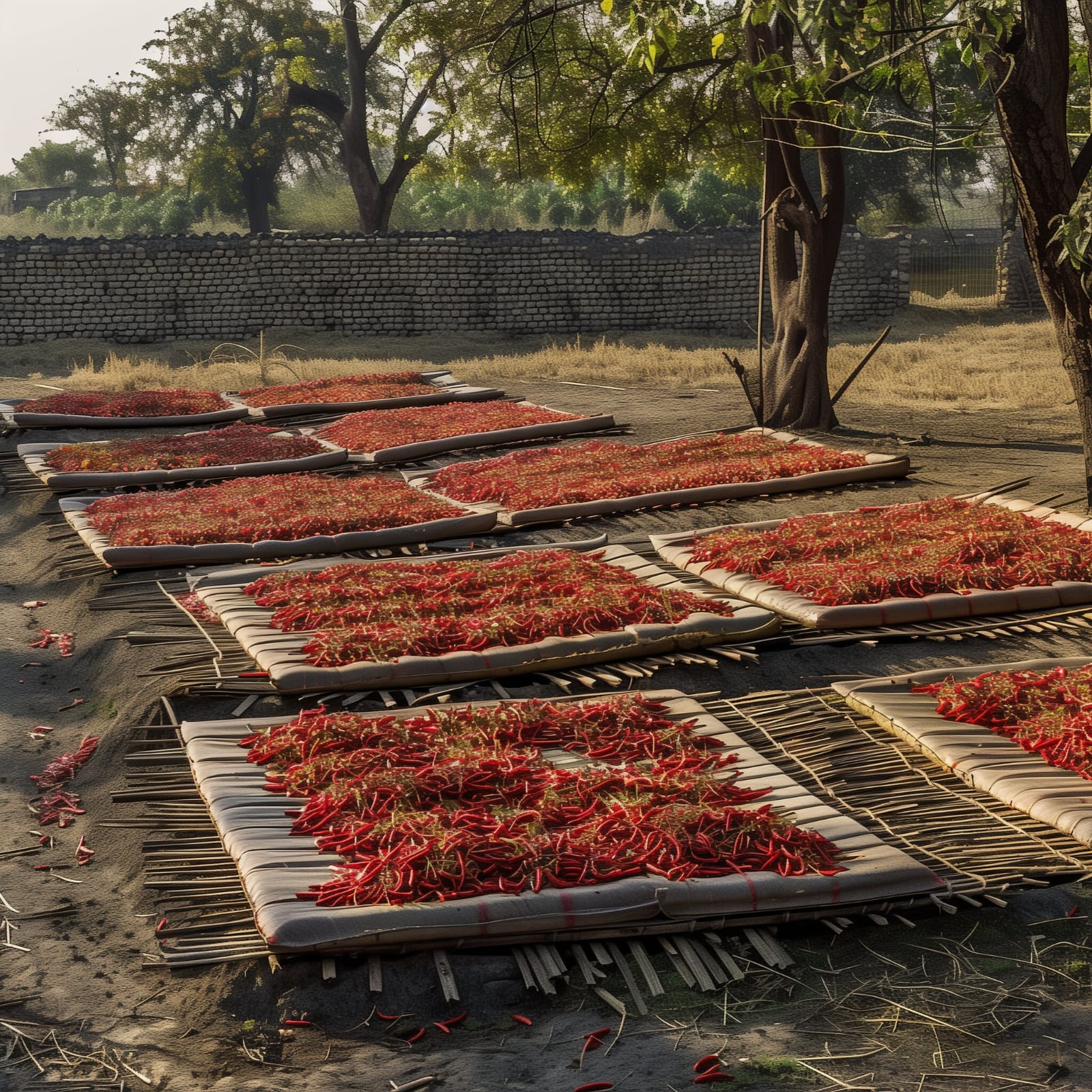
What Happens During Drying
A freshly harvested chilli is roughly 80% water by weight. Drying removes that moisture so the chilli can be stored, transported, and ground. But drying is not a neutral process. The active compounds in a chilli — the oils that carry flavour, the carotenoids that produce deep red colour, and the capsaicinoids that deliver heat — are sensitive to temperature.
Remove moisture too quickly at too high a temperature, and these compounds begin to break down before the water is fully gone. The result is a dried chilli that has lost a significant portion of its quality before it ever leaves the farm. Understanding this is the key to understanding why drying method is not a marketing distinction — it is a direct determinant of what ends up in your food.
Traditional Sun-Drying — The Process in Detail
In traditional open-air sun-drying, harvested chillies are spread across flat drying yards or raised mesh platforms under direct sunlight. The process runs for 5 to 10 days, depending on ambient temperature and humidity. Farmers turn the chillies regularly — typically once or twice daily — to ensure even exposure and prevent localised moisture buildup that could lead to mould on the underside.
The ambient temperatures involved are relatively gentle: 30 to 45°C in peak Andhra Pradesh sun. This slow process allows moisture to leave gradually while the chilli's natural oils and aromatic compounds concentrate rather than evaporate. By the time the chilli is fully dried, it has become a denser, more intense version of itself — with all the compounds present in the freshly harvested pod still largely intact. Moisture content typically reaches 8–12%, the standard for long-term storage stability.
Industrial Machine-Drying — The Commercial Alternative
Industrial dryers use forced hot air, typically at 60 to 90°C, to remove moisture from chillies in 4 to 12 hours instead of days. The output is consistent, controllable, and fast. For bulk producers processing tonnes of chillies per day, that speed is economically essential. The trade-off is direct and measurable.
High heat denatures volatile aromatic compounds and degrades carotenoid pigments — the same compounds responsible for the characteristic red colour and complex aroma of a quality chilli. The result is a chilli that looks red but lacks the layered flavour of one dried slowly under open sky. Some producers compensate by adding artificial colour — typically Sudan Red or Rhodamine B — both of which are banned food additives. Neither approach recovers what the heat removed. The aroma is gone, and no colourant can replace the volatile oil compounds lost in the process.
The Measurable Difference in the Kitchen
Sun-dried chilli powder releases its aroma the moment it hits hot oil. The scent fills the kitchen immediately — sharp, complex, distinct. The colour that develops in the oil is deep and vivid. The heat in the final dish builds gradually and lingers cleanly. The experience of cooking with good chilli powder is qualitatively different from the experience of cooking with poor chilli powder, and the gap is most noticeable at the moment of blooming in fat.
Machine-dried powder behaves differently. The initial aroma release is weaker. The colour, while present, is less saturated. You may find yourself adding more to achieve the same effect — which increases quantity but not quality. Over time, these differences accumulate into a consistently lower baseline for every dish you make with the ingredient.
How to tell from the label: Most brands do not specify their drying method because most use machine-drying. If a brand specifies 'sun-dried' or 'traditionally dried', that is a meaningful claim. If nothing is stated, assume machine-drying.