
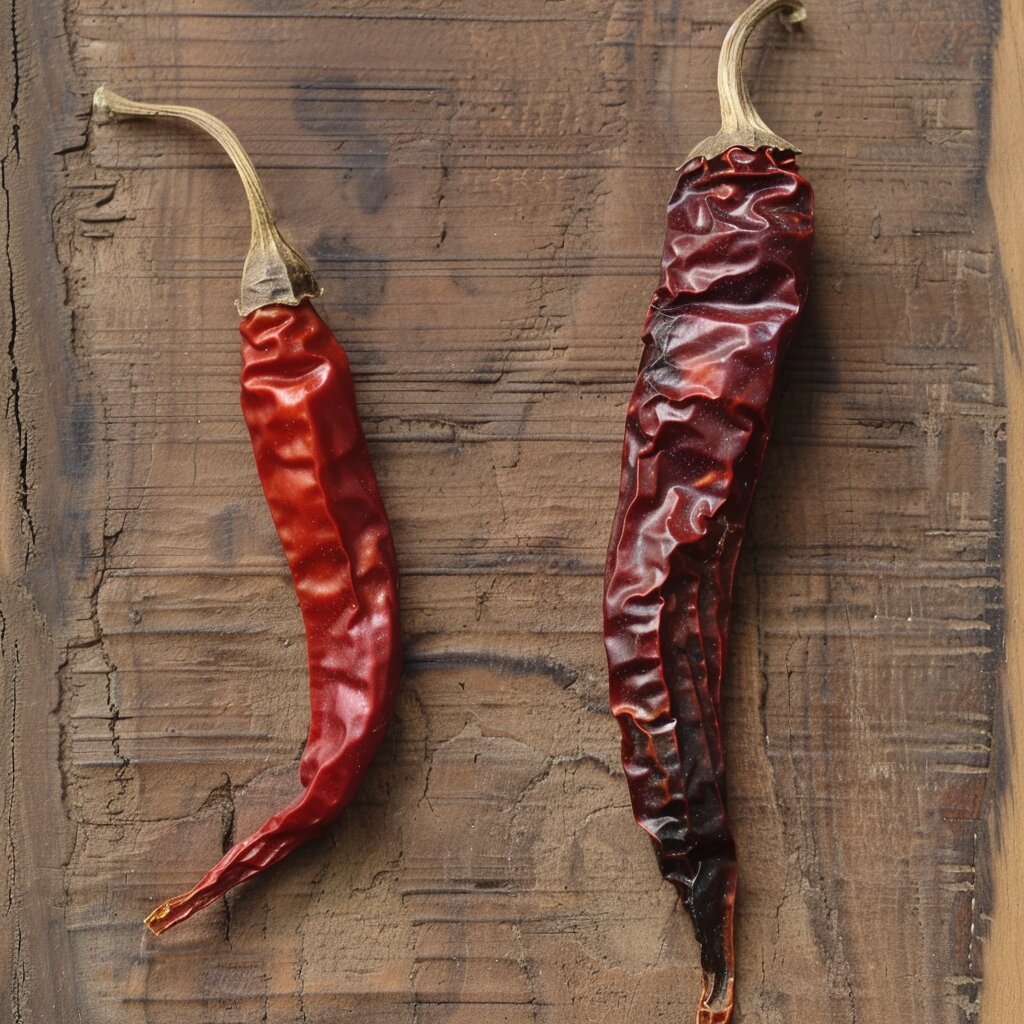
Colour — The First and Most Revealing Indicator
A quality dried red chilli should be a deep, consistent red — not orange, not brown, not faded pink. The colour in a dried chilli comes from carotenoid pigments — primarily capsanthin and capsorubin — which are formed during the final ripening phase when the chilli is still on the plant. If a chilli was harvested before full ripeness, these pigments are not fully developed. The result is an orange or pale red colour that will never deepen.
If the colour has faded to brown, the chilli was either dried at too high a temperature (destroying the carotenoids) or stored in damp, sunlit, or oxygen-rich conditions that accelerated pigment breakdown. A premium sun-dried Guntur Sannam or Byadgi chilli, properly harvested and dried, should maintain a vivid, saturated red colour. Irregular patches — orange near the tip, brown at the stalk end — indicate uneven ripeness or poor drying practice.
Skin Texture and Integrity
Pick up a single chilli and bend it gently. A quality chilli that has been sun-dried properly should be pliable — it will bend without snapping, like thick paper slightly softened by humidity. It should not feel brittle and shatter when flexed. Brittleness indicates either over-drying at high temperature or very old stock that has been stored without moisture control.
Equally, a chilli that feels soft, damp, or leathery to the touch has absorbed moisture during storage — a precursor to mould and flavour degradation. Examine the skin surface: it should have a slight natural sheen from the oils inside. A pale, dusty, chalky surface means the oils have migrated out or the skin has degraded. Also check the stem end: the stalk junction should be clean and dry. A dark, mouldy, or crumbling stalk end is a clear sign of moisture damage at the point where the chilli is most vulnerable.
The Aroma Test — The One Check That Cannot Be Faked
Break or snap open a chilli and smell it immediately. This is the single most reliable quality test and the one commercial packaging makes impossible. A quality dried red chilli should release an immediate, sharp, forward aroma — pungent, slightly smoky, with a faint vegetable-oil warmth underneath. The smell should hit you within a second of breaking the pod.
A flat, papery, or musty smell means the volatile aromatic compounds — which are sensitive to heat, moisture, and oxidation — have degraded. These are the same compounds that give your cooking its depth and character. A chilli that smells of nothing when broken has little left to contribute in the kitchen. A chilli that smells chemical, sulphurous, or of mould indicates contamination or improper storage. There is no way to recover the quality of a chilli whose aromatics have already broken down.
Uniformity Across the Batch
Quality is not just about individual chillies — it is about consistency across the batch. Open your pack and look at the chillies as a group. They should be broadly similar in colour, size, and condition. A mixed batch — with some deeply red chillies alongside pale orange ones, or some whole pods alongside many broken pieces — suggests the lot was not properly sorted before packing.
Broken pieces expose the inner seed chamber to oxidation, accelerating flavour loss in the rest of the batch. Seeds that have spilled and mixed into the batch freely indicate rough handling. WGAN Farms hand-sorts every batch before packing, removing underdeveloped, broken, and off-colour pods. What reaches you in the pack is a consistent grade — not a mixed harvest.
When in doubt, buy whole: When in doubt, buy whole dried chillies rather than powder. Whole chillies preserve their active compounds far longer than ground product, and you can assess quality directly before use. A chilli that passes the colour, texture, and aroma test will outperform any pre-ground powder of similar origin.